Attempting to eradicate all pests from my plant collection
Table of Contents
Objective
Kills spider mites, thrips, broad mites, flat mites, root mealybugs, and other soft-bodied pests by displacing air with CO₂ inside a sealed container. Killing eggs and root mealy bugs will require multiple treatments.
Target parameters
| Parameter | Target |
|---|---|
| CO₂ concentration | ≥60% |
| Temperature | 25–30°C |
| Duration | 24 hours |
| Repeat | Every 7 days, 3 treatments total |
Phase 1: cheap, small-scale experiment
Supplies
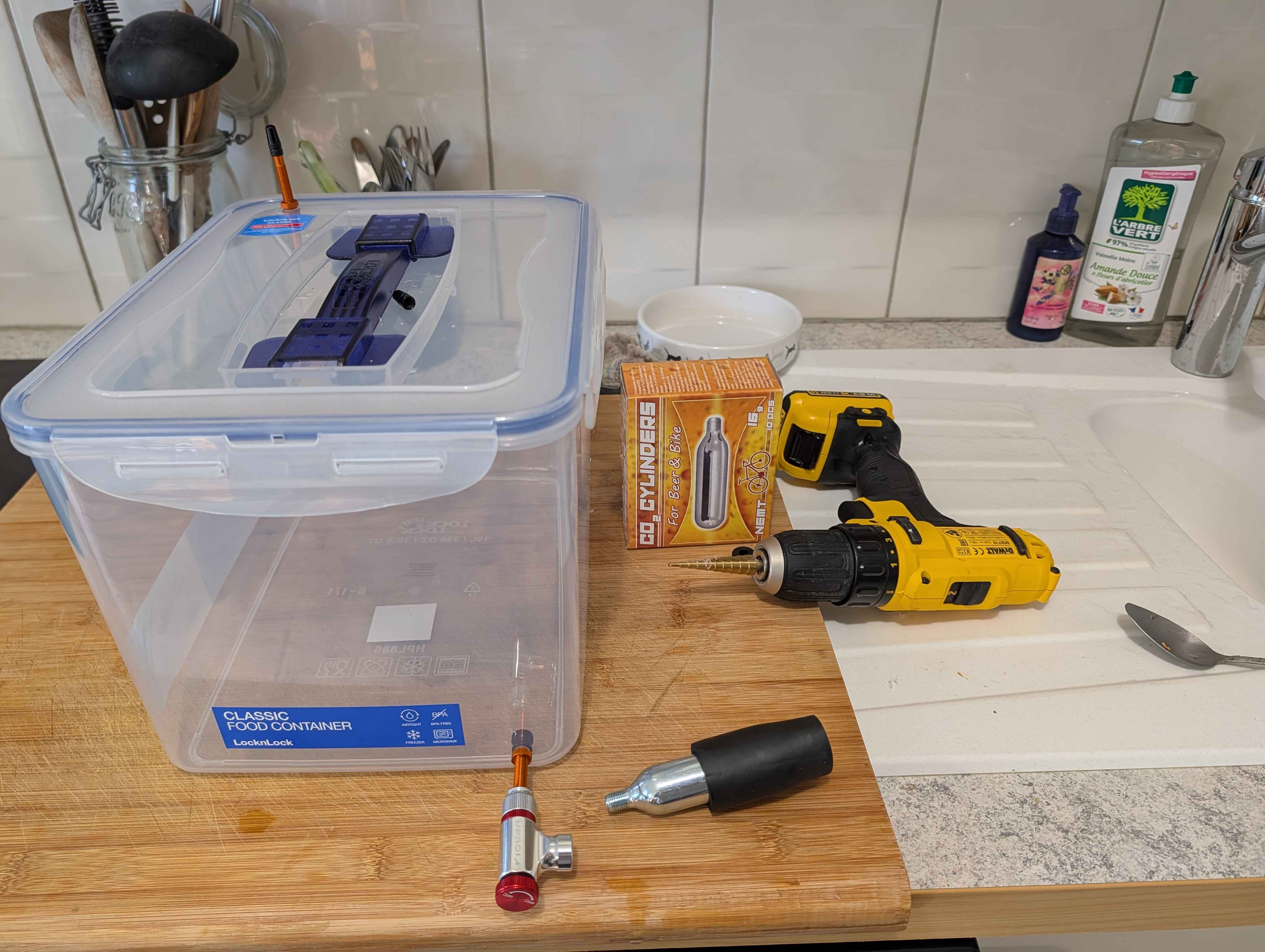
- Airtight 10L box
- 2× Presta Tubeless Tire Valve
- CO₂ bike pump
- 16g CO₂ cartridges
- conical drill bit
General idea
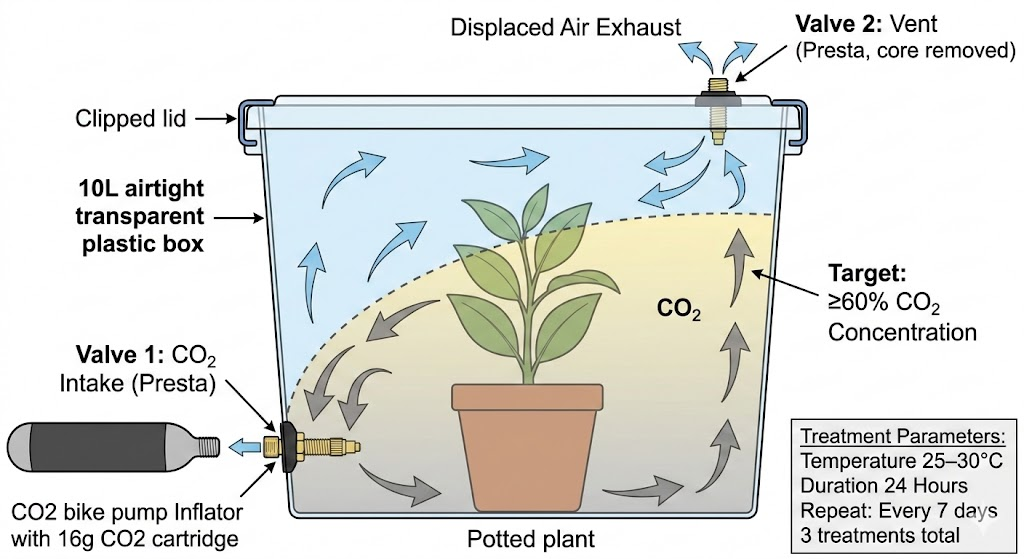
One 16g CO₂ cartridge produces around 8.9L of CO₂ gas at 25°C. In a 10L container, assuming some loss from the imperfect displacement, the concentration should be above 60%. Note that consumer CO₂ sensors won’t measure CO₂ concentration above 10000 ppm, so we can’t use those to check that we get the correct values.
The idea is to release CO₂ into the bottom of the box. Being heavier than air, it will fill the bottom first, and push the air out through a vent on top.
One tubeless tire valve inserted at the bottom of the box will serve as the intake, and another will serve as the vent. They come with O-rings and locknuts to make the holes airtight.
Use the bike pump to release CO₂ into the box with the air vent open, then close the vent. Now wait for 24 hours and pray that this whole idea was not doomed to fail because I’ve missed some obvious reasons for it to fail.
Questions
- How will I check that the box is airtight enough? Should I try first with a small amount of CO₂ and use my CO₂ sensor to check that the value is stable?
- Will I get 100% CO₂ at the bottom and <1% at the top of the box? How to make the whole atmosphere of the box actually 60% CO₂?
- Maybe a small fan?
Assembly
- Drill a 7mm hole in the side wall, a few cm from the bottom → insert Valve 1 (CO₂ input) from inside, tighten locknut on outside
- Drill a 7mm hole in the lid, ideally on the opposite side from Valve 1 → insert Valve 2 (vent) from inside, tighten locknut on outside
- The rubber base of each valve compresses against the plastic to form an airtight seal
Note: drilling into plastic might break it, that’s why I will be using conical drill bits.
Treatment procedure
- Place plant inside the box, close and clip the lid
- Remove the valve core from Valve 2 (vent) using the included tool — this opens it as a vent hole
- Screw a 16g cartridge into the bike inflator, attach the inflator to Valve 1
- Slowly release CO₂ over 30–60 seconds using the regulation knob. CO₂ enters near the bottom, sinks (1.5× heavier than air), and pushes air up and out through Valve 2
- Screw the valve core back into Valve 2 to seal the chamber
- Detach the inflator from Valve 1. The Presta valve self-closes
- Place in a warm spot (25–30°C) for 24 hours
- Complete darkness for plants with C3/C4 metabolism
- Under lighting for CAM plants
- Open outdoors or in a well-ventilated area (high CO₂ is dangerous to breathe)
- Repeat after 7 days, then again after another 7 days (3 treatments total, for eggs)
Plant safety notes
- C3/C4 plants (most tropicals, aroids, ferns): treat during the dark period (stomata closed at the night)
- CAM plants (cacti, succulents, orchids, hoyas): treat during daylight (stomata closed during the day)
- Thick-leaved plants tolerate 60% CO₂ for 24h well; thin-leaved species are at higher risk
- Note: that AI claim that has not been reviewed yet
- Test on one expendable plant first
Pest-specific notes
Note: this table needs to be reviewed using trustworthy sources.
| Pest | Efficacy at 60% CO₂ / 25–30°C / 24h |
|---|---|
| Spider mites (all stages incl. eggs) | Excellent |
| Thrips (adults + larvae) | Excellent |
| Thrips eggs (in plant tissue) | 24h at 60% needed |
| Broad mites / flat mites | Expected excellent (thin cuticle) |
| Root mealybugs | Good if bare roots or porous substrate, several treatments might be needed |
| Aerial mealybugs | Poor: waxy coating protects them; consider other methods |
| Fungus gnats | Good |
Safety
To be done outdoors in a well-ventilated area, especially when opening the box at the end of the treatment.
Shopping list
- tubeless valves https://fr.aliexpress.com/item/1005006614039398.html 3.89€
- CO₂ bike pump https://fr.aliexpress.com/item/1005010155203894.html 5€
- cartridges https://www.amazon.fr/dp/B00DDN4MEQ 10€
- box https://www.amazon.fr/gp/product/B01J5P32ZA 17€ (would be cheaper at IKEA)
Total: 40€ if I can’t find a cheaper box.
Results
First attempt - Cacti with thrips and root mealybugs
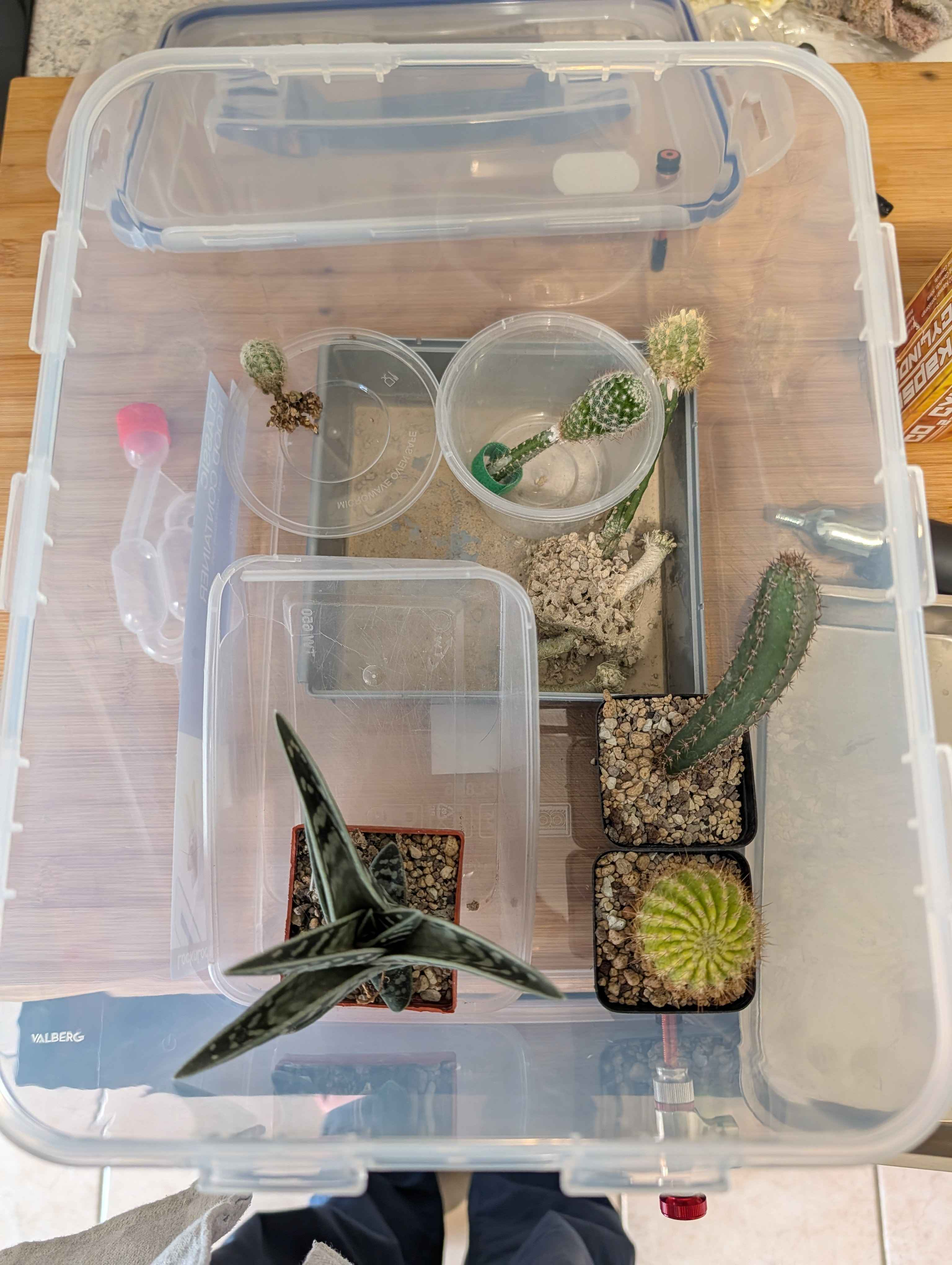
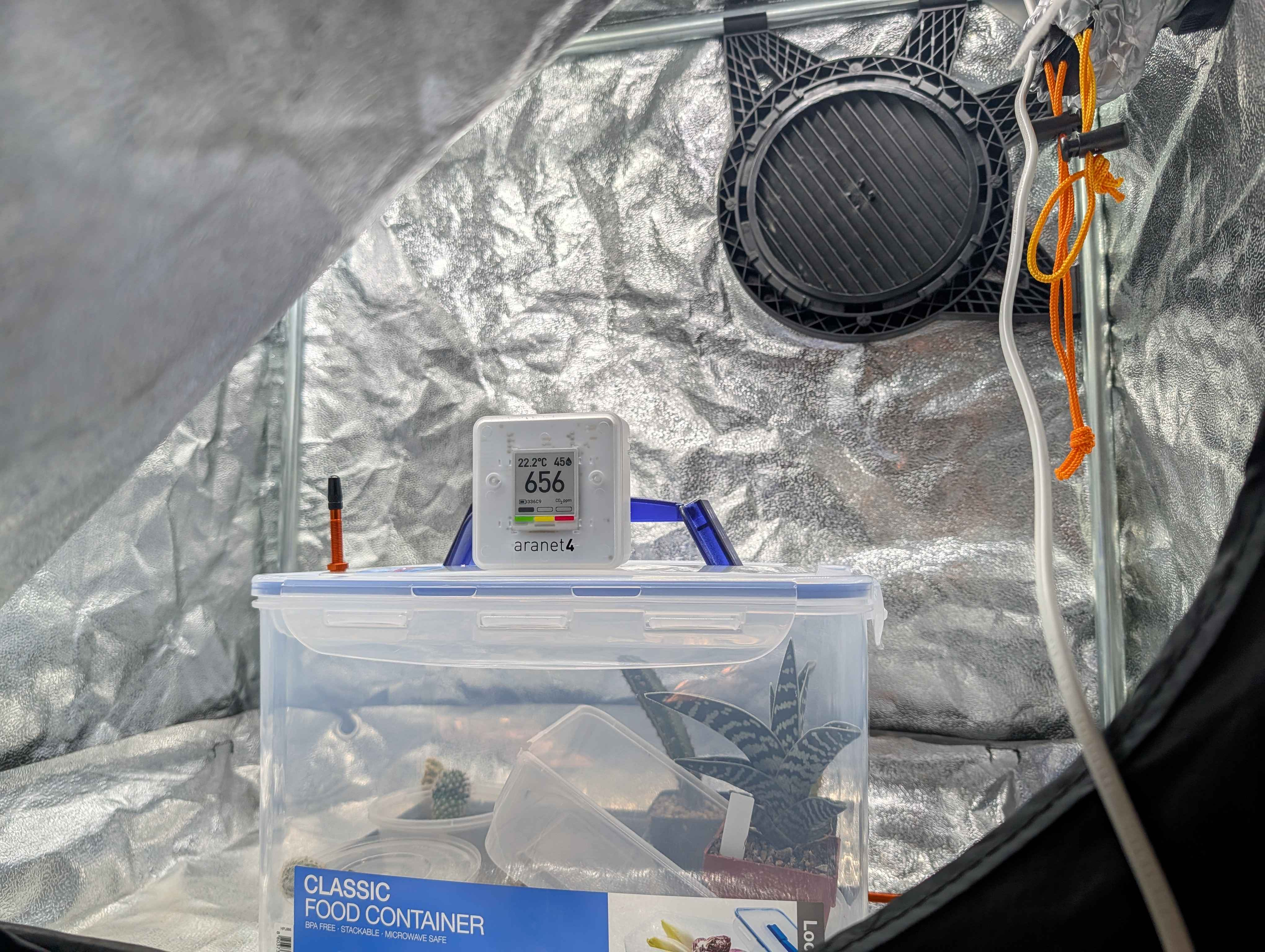
Since all those plants have CAM metabolism, I placed the box in a tent with lights on. My Aranet4 sensor can’t measure above 10000ppm (1% concentration), but I placed it in the tent to see if it leaked.
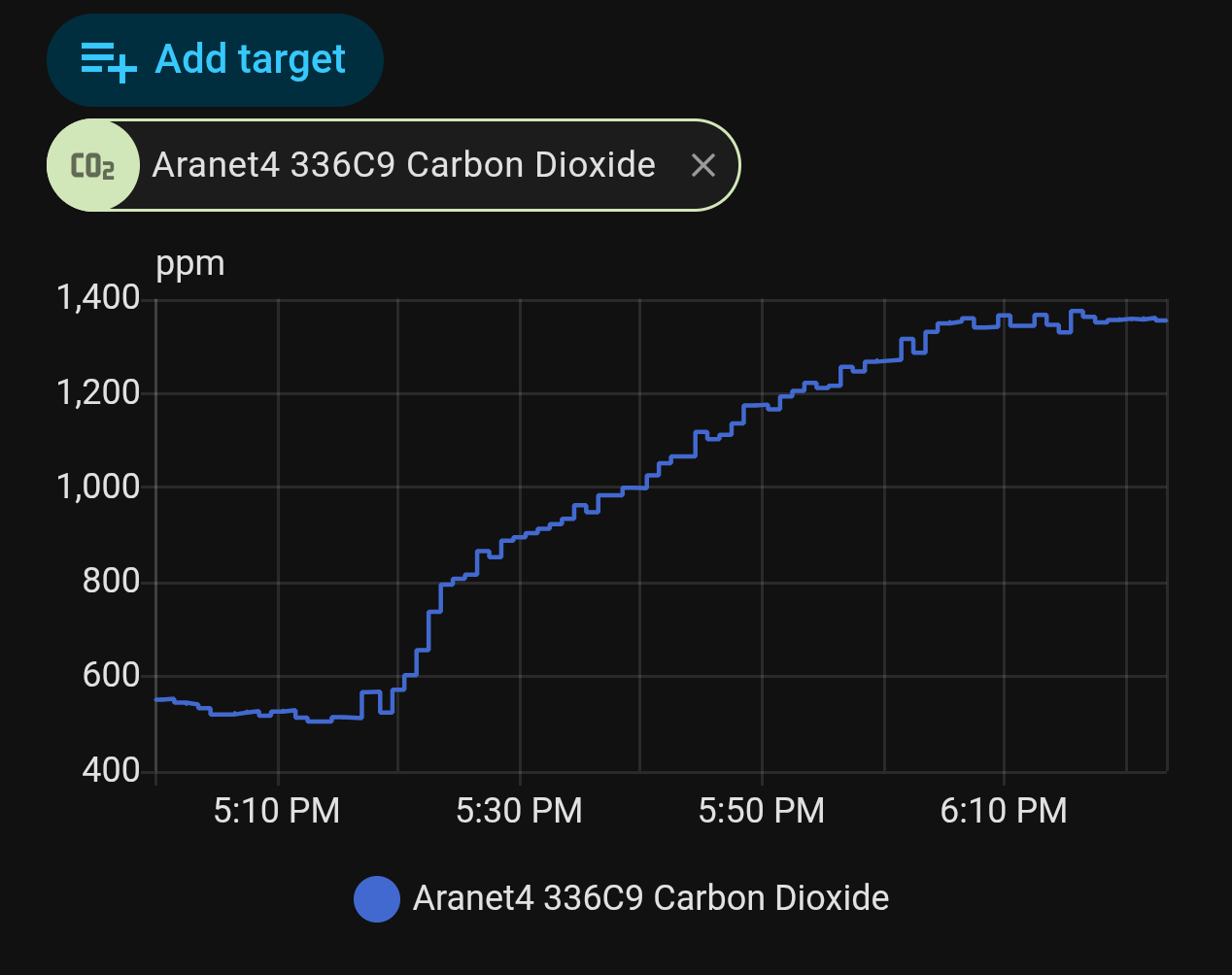
Concentration rose, and I was concerned that the box was leaking too much to keep the concentration high for 24 hours.
However, when I opened the box, I placed the sensor inside and closed it again (making sure to stay as far as I could to avoid intoxicating myself).
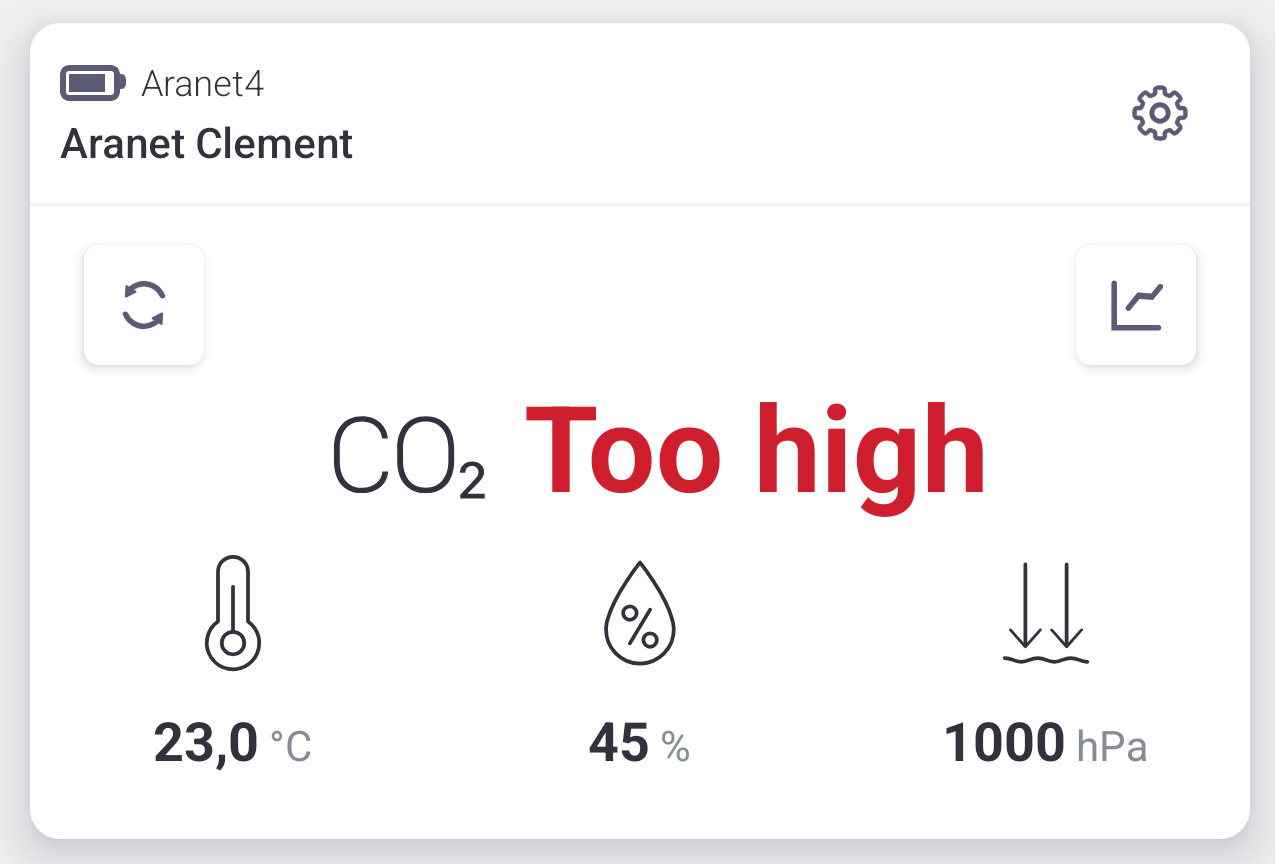
Above the 10000 ppm limit! Since CO2 is denser than air, I think I can assume that the CO2 concentration on the bottom of the box stayed high enough.
I spent some time inspecting the plants with my USB microscope, and didn’t see anything moving the next day, a few days after that and two weeks after.
Success? I’m not sure. Getting proof that there are root mealybugs by seeing some crawlers move is easy… but not seeing anything move doesn’t mean there aren’t any live pests still hiding and staying still…
Second attempt
Plants: Tradescantia (some cuttings that started to make roots, and two rooted plants), Coleus cutting and Passiflora cutting.
I’m not expecting the Passiflora cutting to survive and make roots, but it was had dozens of thrips so it was a good test to see if they the pests would survive.
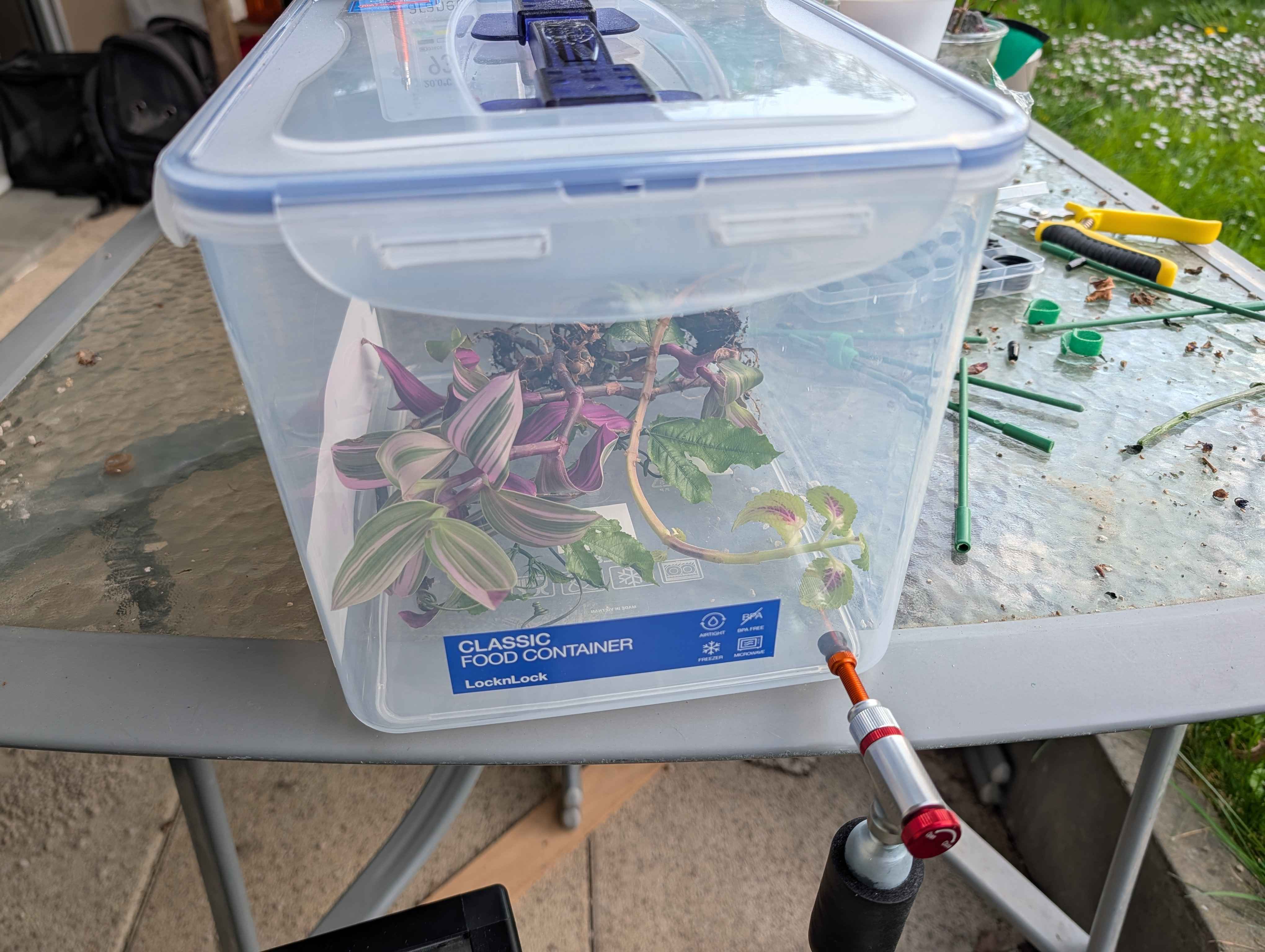
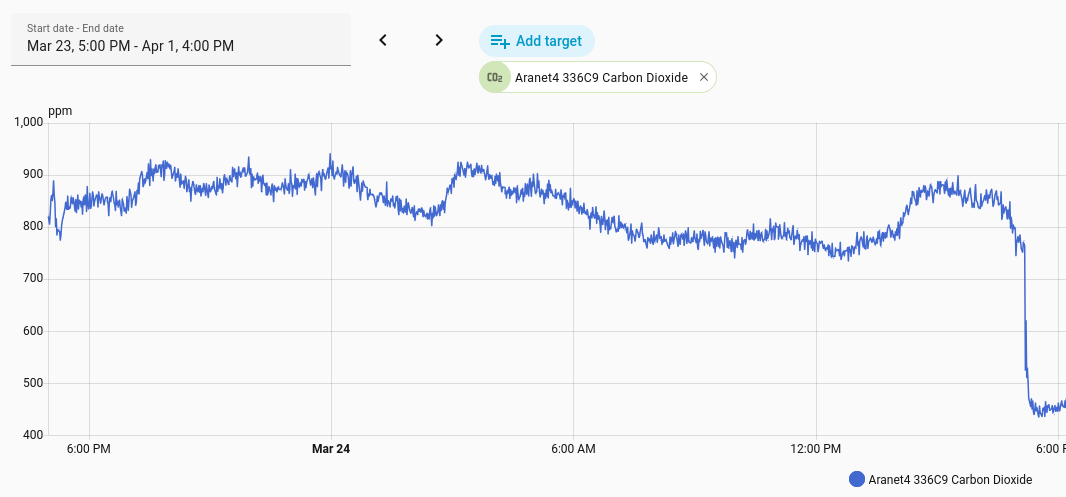
This time I added a few more O-rings on the presta valves. It seems to have worked, because the CO2 concentration didn’t rise in the tent.
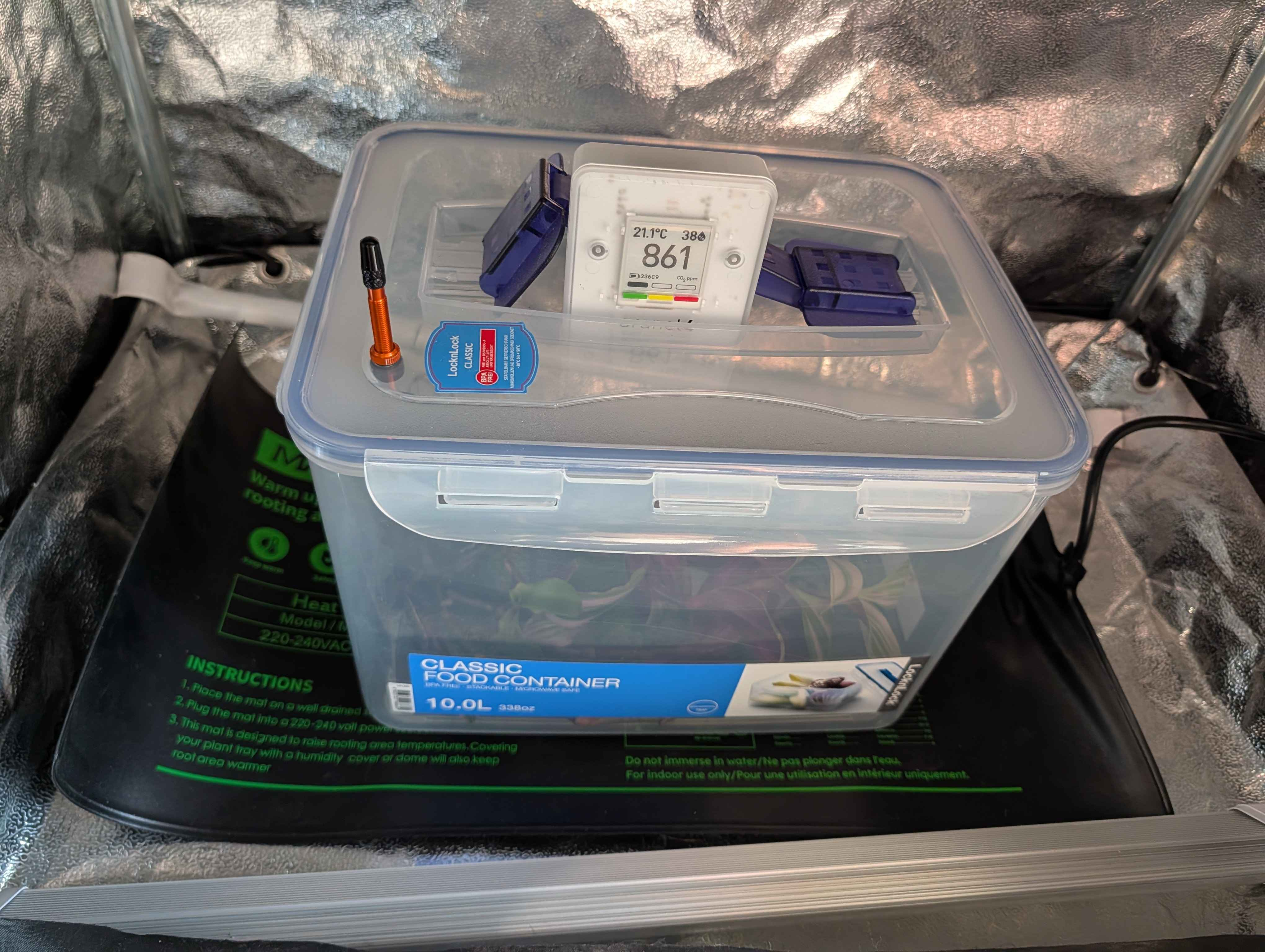
I added a heat mat under the box, because according to this paper, thrips mortality (including eggs) in CO2 increases with temperature: https://www.researchgate.net/publication/257802832_Insecticidal_effect_of_high_carbon_dioxide_atmospheres_on_thrips_eggs_oviposited_in_plant_tissue
Since those plants do not have CAM metabolism, I closed the tent with lights off.
To be continued
(Spoiler: 24 hours later, the bottom of the box was covered with dozens of dead adult thrips!)
Phase 2: Large scale eradication of all pests in my collection
- 2kg CO₂ canister (can be refilled for cheap) or sodastream canisters (needs adapter for regulators)
- The canister will have to be weighed to know how much CO₂ has been released into the box
- Aquarium CO₂ regulator, maybe something like this https://fr.aliexpress.com/item/1005002734071160.html
- larger box (160L)
- If the box is opaque, might need to install LEDs in the box for CAM plants
- rubber grommets https://fr.aliexpress.com/item/4001045359889.html
- Aquarium tube pipes https://fr.aliexpress.com/item/1005007964433144.html
Will be significantly more expensive because of the large box, the canister and the regulator. Depending on the number of treatments needed, sodastream canister + adapter will have a lower upfront cost, possibly under 100€.
AI disclaimer
- Researched with Claude, Gemini and ChatGPT deep research, but reviewed by me unless noted otherwise
- text mostly written by me
- schematics by gemini